stablein-min

Customer case study

Stäblein Architekten

Closing the As-Built gap from pharma to heritage projects

Innovative approach to refurbishments

STÄBLEINARCHITEKTEN is a German architecture firm that specializes in designing sustainable and innovative buildings. The firm provides architectural design, BIM coordination, and construction supervision services. The team is committed to digitalisation in the construction industry and belongs to the BIM pioneers in Germany.

They are also playing a pioneering role in the field of digitalization for existing buildings' and leverages BIM, 3D scanning and digital quality control to optimize the design, planning and construction phase.

For existing properties, the efficient documentation of as-built data and the precise planning of modifications is a key challenge.

As part of its efforts to continuously improve its processes through modern tools and better use of data, Stäblein started rolling out Imerso routines across its projects. The team wanted to explore the versatility of the Imerso platform, and see how well it performed across various different project types:

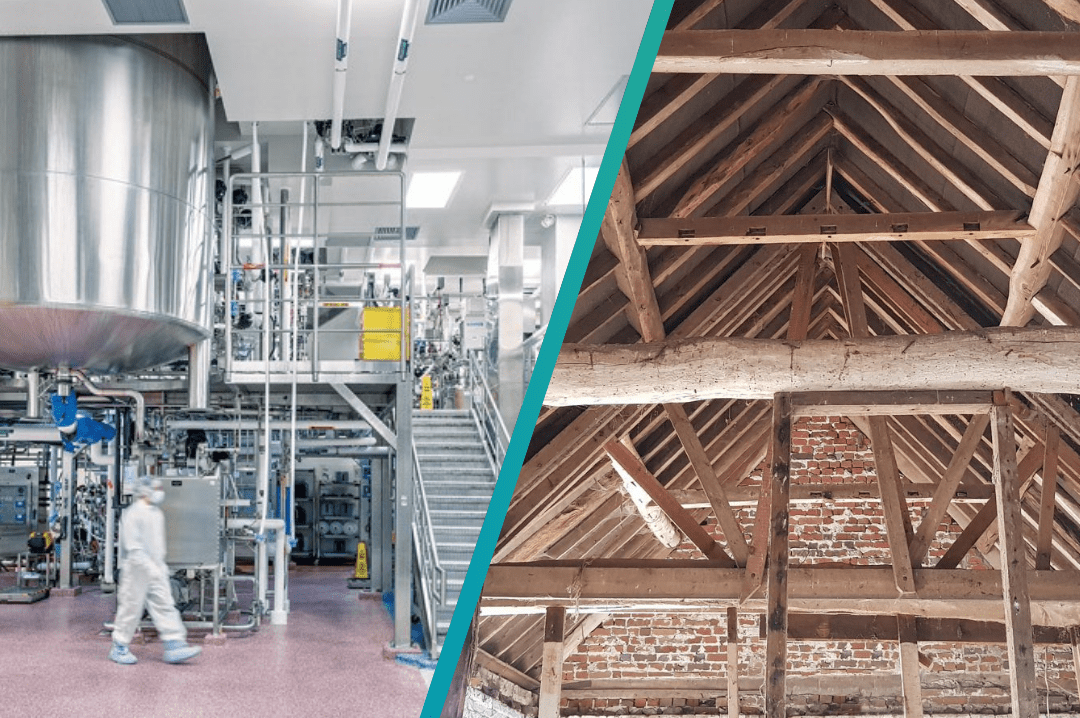
  • Pharma: Refurbishment of an existing and operative Pharmaceutical production facility.
  • Residential: Refurbishment of a multi-storey 3.600 m2 residential property with energy-efficient facades.
  • Heritage: Conversion of a historic 450 m2 Churn barn.
9717dfa180004babb59b8e43cfb5de50-min

Manual and visual documentation doesn't give us full confidence in our designs, since many areas may not be measured accurately.

Ulla Stäblein, Managing Partner
Lack of reliable As-Built documentation

Common to all refurbishment projects, the Stäblein team faced challenges from the lack of accurate As-built information of the existing building conditions. Read here about The Critical Role of As-Built Data in Construction, in particular for refurbishment of existing buildings.

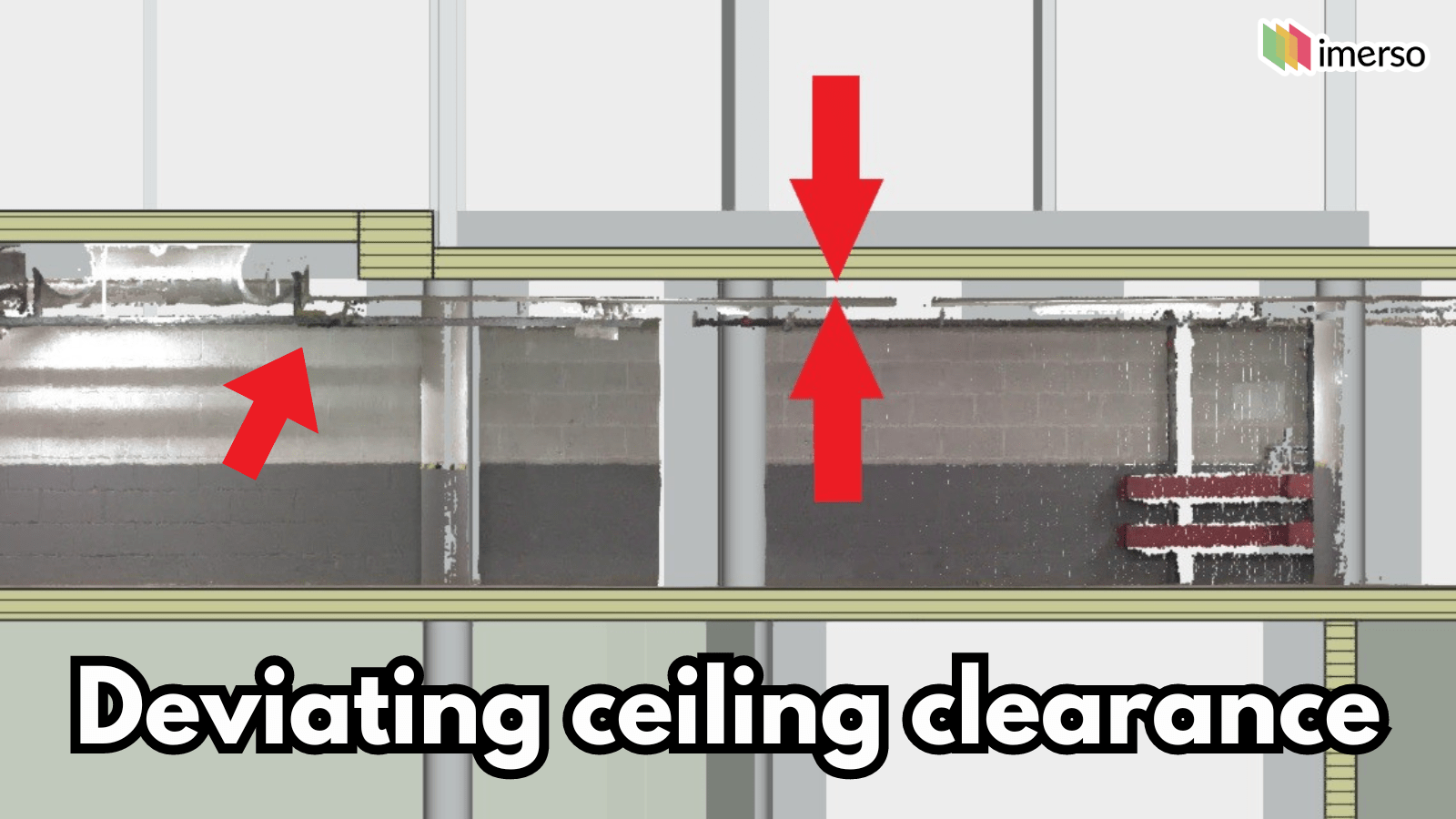
The Pharma project was particularly difficult, as it required addressing complex technical installations in very high ceilings without disturbing the continuing operations at the site. The Residential project faced the typical challenge of carrying out an inventory survey of the existing building in a fast and cost-effective way - without scaffolding, ladders or disturbing the residents too much - in order to start designing the new facade as soon as possible. And finally, there was the challenge of documenting and refurbishing a historically protected property.

"Each of these projects has its own unique challenges: from preserving cultural heritage to working in a pharmaceutical plant where production cannot stop. The types of the project differ greatly, but the fundamental challenge of recording accurate as-built documentation and planning modifications as precisely and efficiently as possible remains the same," says Ulla Stäblein.

Traditional approaches are not enough

STÄBLEINARCHITEKTEN recognized the added value of 3D laser scanners and point clouds right from the start, instead of carrying out manual measurements in their projects.

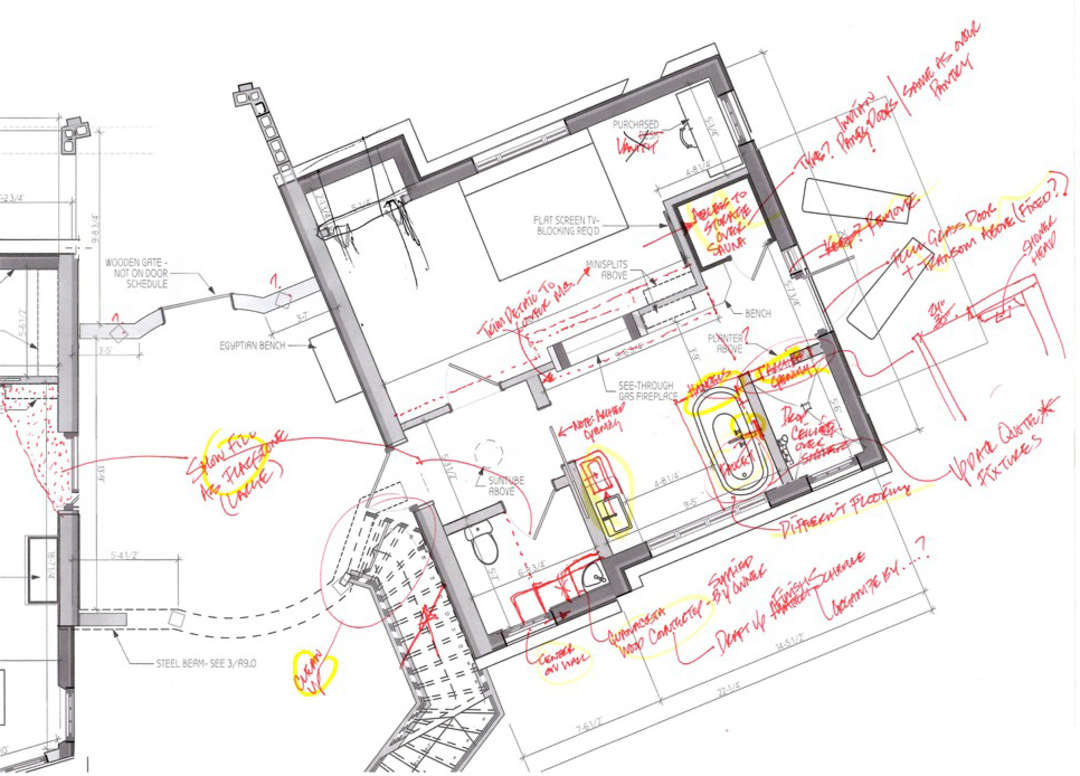
"In-person visits to collect manual measurements and photos are extremely time-consuming and only provide a sparse and incomplete record of the buildings condition," says Ulla Stäblein. "This doesn't give us full confidence in our designs, since many areas may not be measured accurately, and we have no way to know exactly where the models differ from reality and by how much."


stablein ceiling_en-min

The lack of complete information in the early plans means that the most likely outcome will be having to improvise solutions on the spot during the construction phase.

Erhard Stäblein, Managing Partner
The risk carries from planning into the entire construction phase

"The lack of complete information in the early plans means that the most likely outcome will be having to improvise solutions on the spot during the construction phase and deal with issues as they come", says Erhard Stäblein.

A not very sustainable, but unfortunately all too common practice is when built elements have to be dismantled again because too many hidden errors have accumulated. Searching for solutions at the last minute with insufficient information costs time, resources and a high level of coordination between the trades.

These challenges can be exacerbated in heritage-listed projects, as planning errors cannot be easily rectified during the construction phase because the protected elements may not be altered.

When it comes to capturing data of exterior components such as façades, scaffolding and ladders are required to reach objects at such heights. In addition to safety concerns, these scaffolding systems have to be ordered and installed, and the data basis is still only a manual measurement with photos.


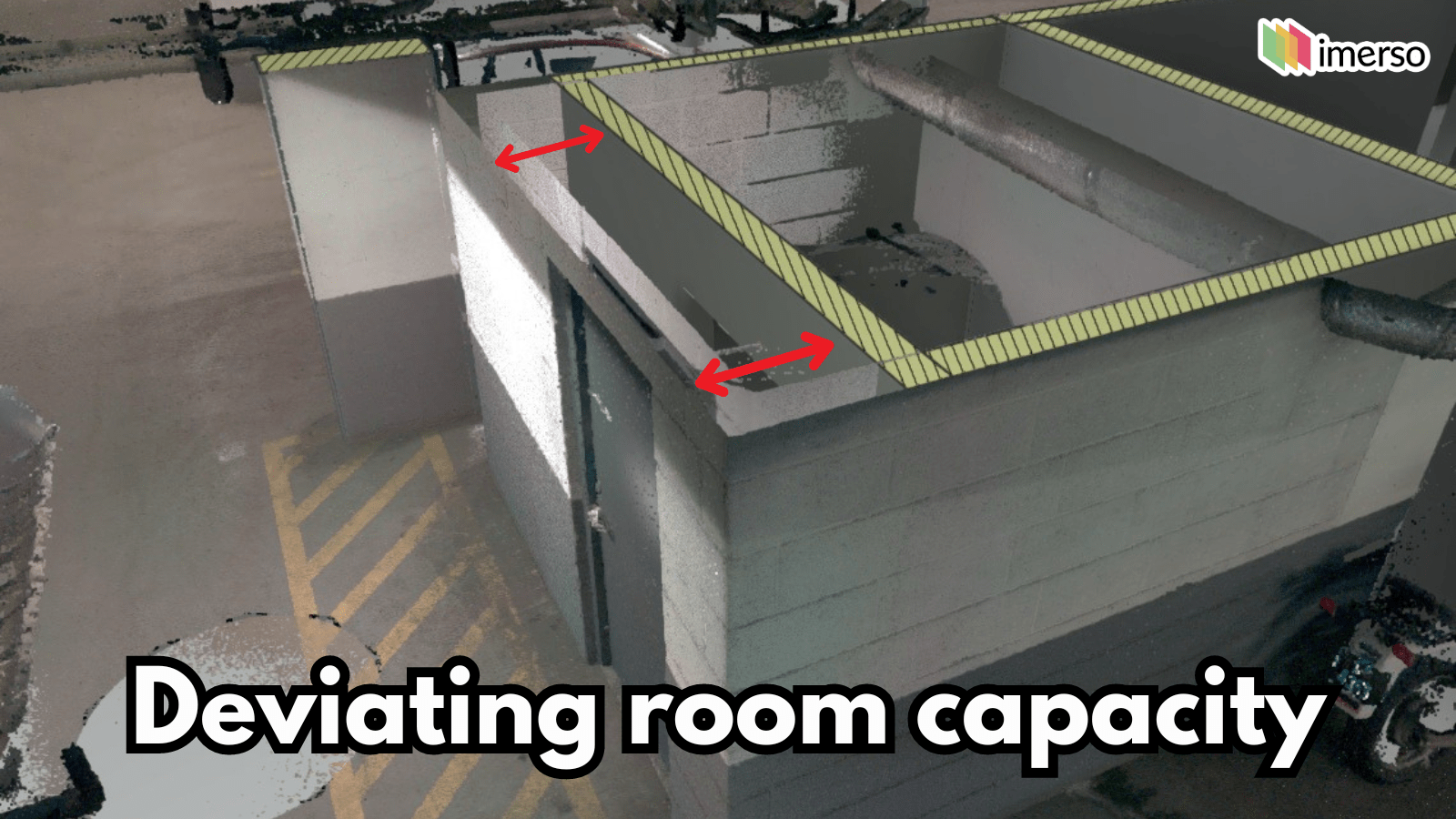
stablein  room_en-min
The team leverages Imerso to resolve several typical challenges:
01 Waste of time and labour costs carried in measurements, modelling, and re-planning.

02 High likelihood of costly errors, dismantling and project delays.

03 Lack of reliable ground-truth information to keep all teams coordinated and on the same page.

Implementing laser scanning and BIM verifications with Imerso

To resolve these challenges, STÄBLEINARCHITEKTEN uses a BLK360 laser scanner from Leica Geosystems. This can be used directly with the Imerso app. With this small, handy scanner, the Stäblein team can carry out 3D surveys in their projects and capture millions of millimeter-precise measurements in minutes without having to use external services.

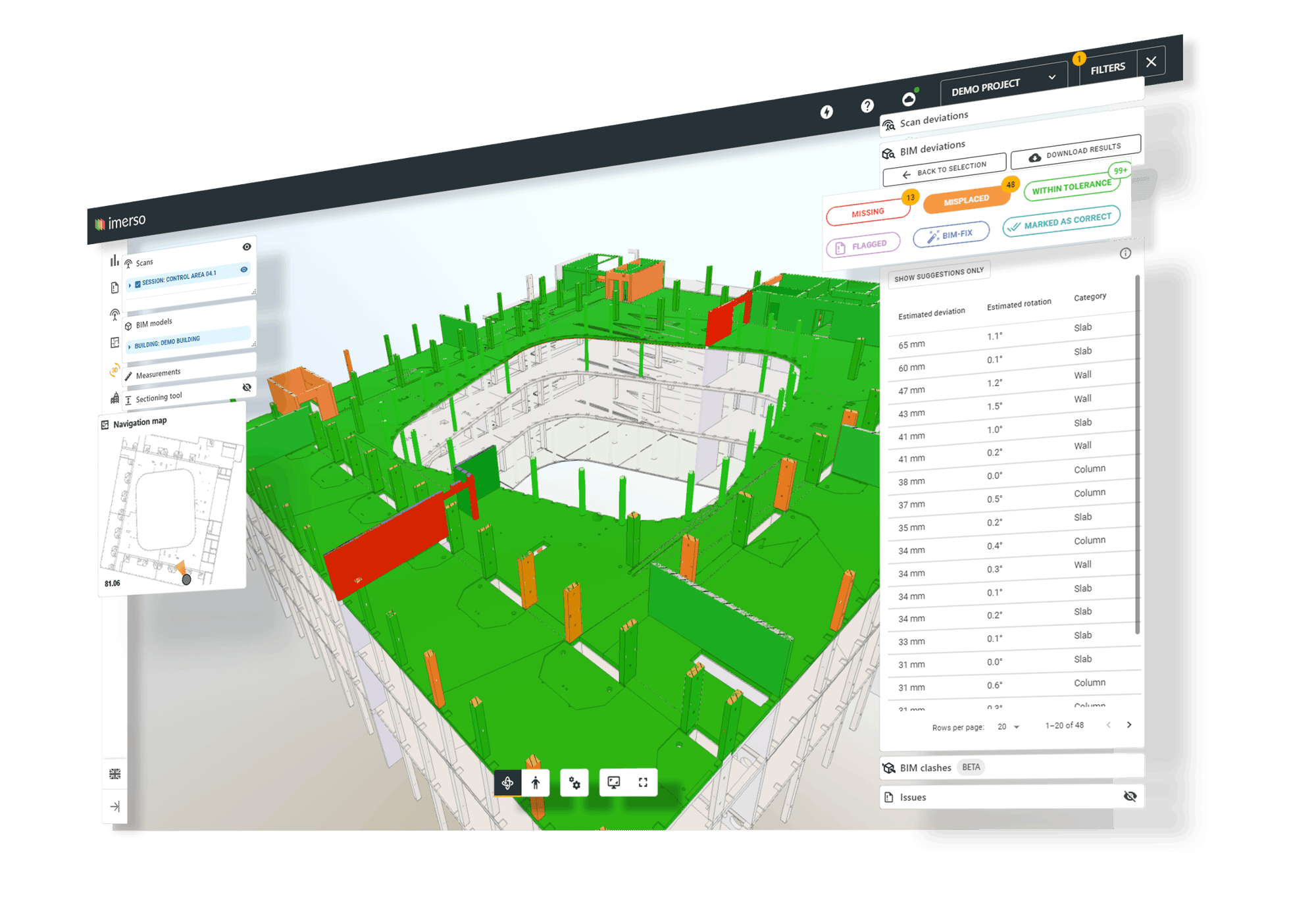
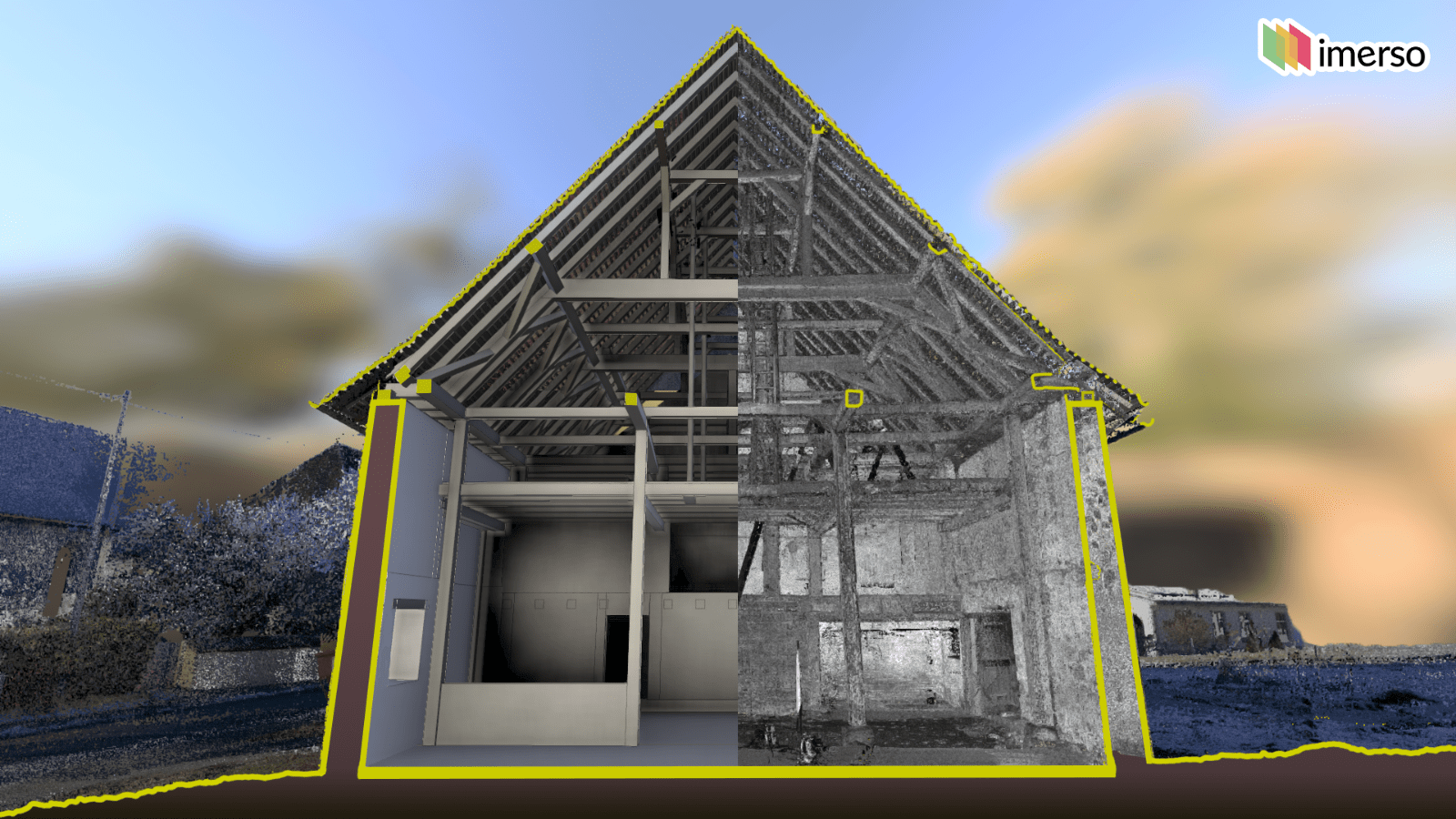
The point clouds are automatically synced to Imerso, and analysed against the BIM models. Using this approach allows integrating accurate As-Built information early in the design and planning phases, both for correcting mismatches between the models and reality, as well as ensuring that everything can be built according to plan

The team was also able to use Imerso to rapidly analyse multiple design variants on how well each can fit the existing building structure, in order to rapidly identify the best design choices.

Efficient project planning

STÄBLEINARCHITEKTEN saw a threefold effect after just a few weeks:

  • Optimized design choices and verified solution proposals for the client already in the early project phases.
  • Accurate data basis, which improves the coordination of trades and enables efficient controls during construction.
  • Ability to provide the client with accurate as-built documentation before and after construction.

"The Mixed Reality view in Imerso allows us to navigate the as-built status in detail together with the BIM models and bring everyone on the same page. We save on recurring project inspections due to missing measurements and are able to carry out more extensive checks, such as surface and inclination analyses, in the digital twin," says Ulla Stäblein.

"We carry out collision checks digitally in advance instead of being surprised by them onsite. This enables much smoother construction processes and eliminates the risk of costly construction surprises," says Erhard Stäblein.

As soon as the construction phase begins, STÄBLEINARCHITEKTEN frequently documents the construction progress and checks whether the plans have been implemented onsite as planned. The complete 3D data in Imerso makes it possible to detect even the most hidden deviations and check the assembly accuracy and dimensional accuracy of the components onsite.

"Our problem-solving process has become much more efficient, as we can detect and communicate all contextual information directly in the digital twin. At the same time, we capture highly accurate documentation of the entire construction progress."

We now carry out digital collision checks in Imerso between our models and the As-Built reality in advance, instead of being caught by costly construction surprises.

Ulla Stäblein, Managing Partner
stablein  mr_logo-min

See what Imerso finds on a real jobsite in 30 minutes

We'll walk you through a live analysis on a real project — and show what Imerso can do.

30 minutes · No commitment · See live results